

A pocket can look right in a product photograph and still be awkward to use. The opening may catch a hand, a phone may pull the garment forward, or the pocket may become difficult to reach when the wearer sits down. For a clothing brand developing a new style, these are useful questions to settle before approving the sample. A practical review starts with the intended use, then connects fit, fabric and construction to that use. Reinforcement is one decision within that process.
Give the Pocket a Specific Job
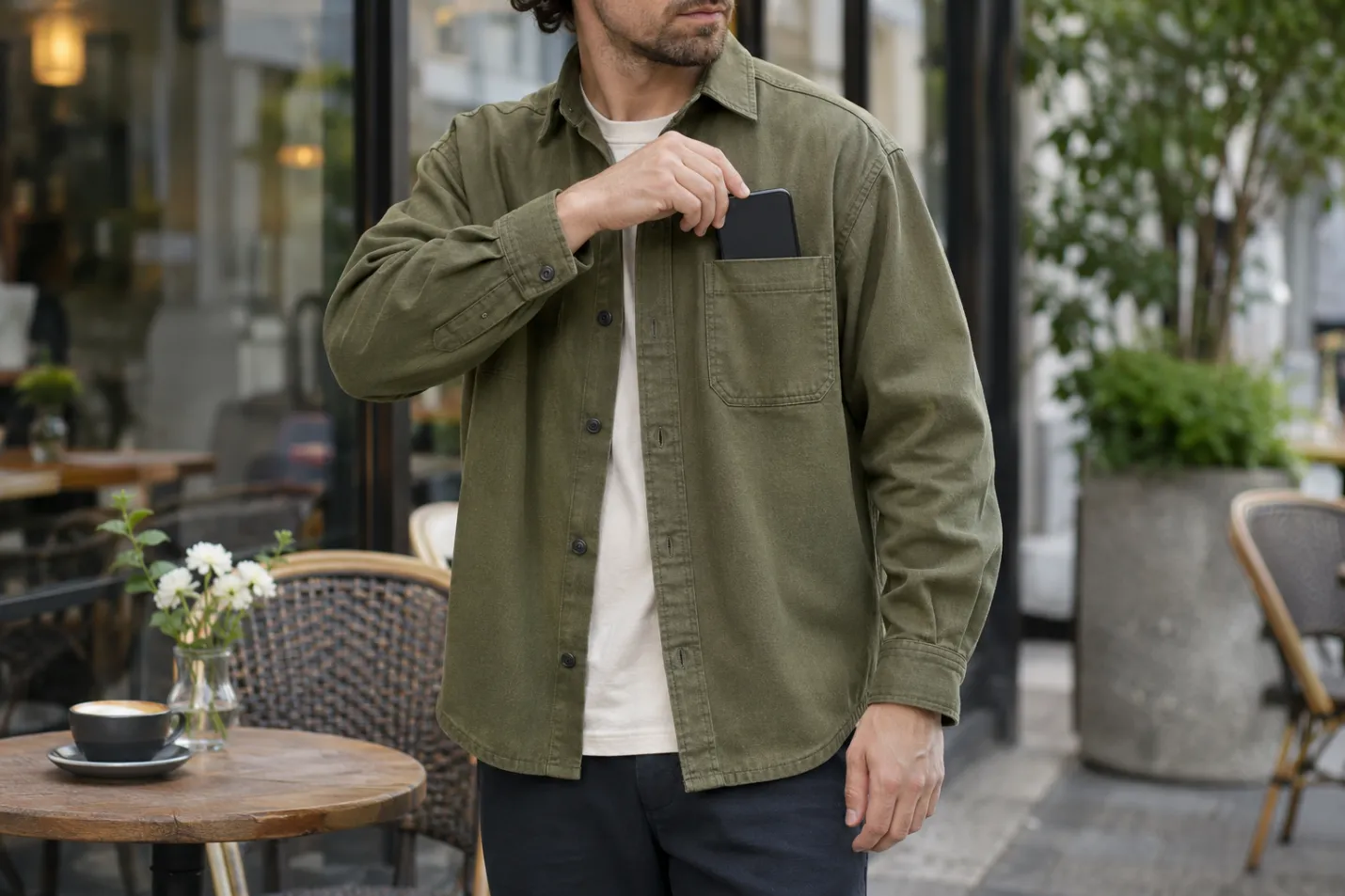
Replace the instruction “make the pocket functional” with a short description of what the wearer should do. A casual overshirt might need to hold a phone while someone stands and walks. A trouser pocket might need to let someone retrieve keys while seated. These are different design situations. Name the object, the movement and the expected clothing layers so the sample maker has a clear starting point. Avoid treating every pocket on the garment as interchangeable.
Use the same representative object when comparing samples. Record its dimensions and whether a case is fitted, rather than writing only “phone fits.” Also decide what the pocket is not intended to carry. This prevents a visual styling detail from quietly becoming an unsupported heavy-load promise. For everyday apparel, the immediate goal is a clear use brief that the designer and sample maker can discuss together.
Separate Access Problems from Support Problems
Review the garment on a wearer for whom the sample size is intended, with the planned underlayers. Observe the pocket empty, then with the agreed object inside. Can the wearer find the opening naturally? Does inserting the object require pulling the whole garment away from the body? Does sitting change access? Record the action and observation without forcing an uncomfortable movement or adding a load that was never part of the brief.
Next, distinguish where a problem begins. An opening that is difficult to enter may need a different angle or position. A phone that presses against the hem may need more pocket depth. A pocket that hangs forward may call for a review of its dimensions, fabric support or garment fit. These are prompts for the pattern and construction team, not diagnoses from appearance alone. Adding extra stitching does not resolve every design problem.
Put Reinforcement in Its Proper Place
Bartacks are local reinforcements commonly used at garment stress points, including pocket openings. Their presence does not establish the suitability of the whole pocket. When a bartack is meant to reinforce an existing attachment, its location and the layers it engages matter alongside its appearance. The relevant detail should be specified for the actual fabric and pocket construction, rather than copied unchanged from another style.
For the construction discussion, the bartack reinforcement and sample approval guide provides a useful reference for separating placement checks from strength evidence. Ask the sample maker to explain what each reinforcement secures and show its relationship to the attachment. Inspect the reverse as well as the face where accessible. Loose stitches, distortion or damage around the stitching deserve investigation. A tidy surface and a high stitch count are not a substitute for an agreed assessment of the assembly.
Compare Revisions with One Clear Question
Imagine a hypothetical overshirt sample whose chest pocket accepts the selected phone comfortably while standing, but whose opening pulls noticeably during normal seated movement. This is an illustrative development problem, not a reported test result. A useful revision request identifies that observation and asks the team to review pocket position and opening geometry. “Improve pocket quality” leaves too many possible interpretations and gives the next reviewer no clear comparison to make.
When the replacement sample arrives, repeat the same action with the same object and comparable layers. Record the sample version and the changes the maker reports. If several features changed together, acknowledge that the review cannot isolate which change produced a difference. Keep comments precise: “opening easier to reach while seated” describes an observation; “proven durable” claims evidence that this informal review has not produced. Any required strength assessment needs its own suitable procedure and acceptance criteria.
Send a Brief That the Next Person Can Use
Bring the decisions together in a compact handover: style and sample version, intended use, reference-object dimensions, pocket position, opening and depth measurements, material details, construction drawing and remaining questions. Attach labelled photographs that show the garment being worn and the relevant detail. State which observations were made before or after the agreed care process. If performance after laundering matters, request a defined review using the planned materials and care instructions.
This also makes a supplier conversation more productive. Ideals Clothing describes development from designs, technical packs or reference samples, alongside options to adapt existing styles. A brand can use that starting point to present both the appearance it wants and the pocket behaviour it needs. Ask which changes are feasible for the selected garment, and confirm the resulting specification in writing. Keep unresolved decisions visible when requesting the next sample.
Conclusion
A useful pocket brief describes a task the garment should support. Review access and fit first, discuss reinforcement in relation to the actual construction, and compare revisions under consistent conditions. The result is a clearer development conversation and a sample decision tied to observable details rather than a vague request for stronger stitching.
Q&A
Should every pocket have bartacks?
No. Reinforcement choices depend on the fabric, attachment, pocket design and intended use. Ask for a construction-specific proposal rather than adding bartacks everywhere.
Does a successful wear check prove pocket strength?
No. It can reveal access or fit issues under the recorded conditions. It does not establish a load rating or replace any required mechanical assessment.
What should change when the fabric changes?
Revisit the pocket’s support, attachment and reinforcement with the new material. Earlier observations may not transfer, even when the pattern and visible styling remain similar.